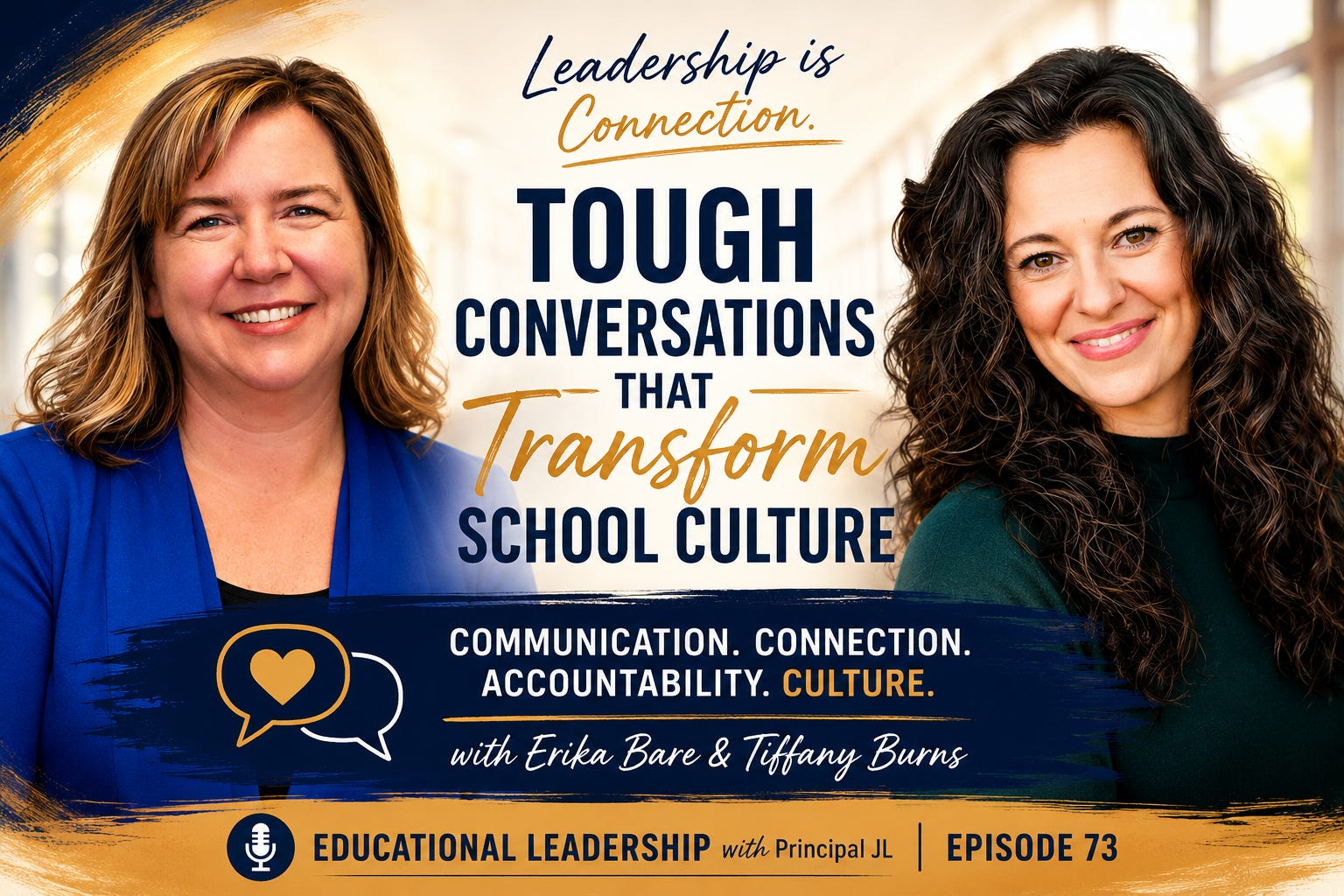
Tough Conversations That Transform School Culture
Educational Leadership with Principal JL Podcast

As school leaders, we often spend significant time discussing systems, structures, strategic plans, and initiatives. While those things matter, one truth remains constant: leadership is ultimately about people.
And people require conversations.
Some conversations are easy. Others are uncomfortable. The conversations we often avoid, whether with students, staff members, or families, are frequently the very conversations that determine the health of our school culture.
In Episode 73 of Educational Leadership with Principal JL, I had the opportunity to sit down with educational leaders, authors, and consultants Erika Bare and Tiffany Burns. Together, they have dedicated their work to helping educators improve communication, strengthen relationships, and create cultures where every student and adult feels valued, supported, and accountable.
Their message was both simple and powerful:
The conversations we choose to have—or avoid—shape the culture of our schools.
Every Student Deserves Connection
Both Erika and Tiffany entered education for similar reasons: they wanted to make a difference in the lives of young people.
For Tiffany, education was an opportunity to help create a better future by investing in children. For Erika, a lifelong love of teaching and supporting younger learners naturally led her into the profession.
Throughout their careers, they discovered something many educators learn over time:
Relationships are not simply important, they are foundational.
Their first book, Connecting Through Conversation: A Playbook for Talking with Students, grew from the realization that while educators deeply care about students, many have never been explicitly taught how to communicate in ways that build trust, belonging, and accountability.
One of the most impactful concepts they discuss is what they call “caring out loud.”
Too often, educators assume students know they care.
The reality is many students walk into our buildings carrying experiences that make trust difficult. They may have encountered adults who let them down, misunderstood them, or failed to support them.
As school leaders and educators, we cannot assume students know we care.
We must intentionally show them.
We must tell them.
We must demonstrate it through our actions and conversations.
When students experience genuine care, trust grows. When trust grows, learning follows.
Why Leaders Avoid Tough Conversations
The discussion naturally shifted toward their newest book, A School Leader’s Playbook for Tough Conversations.
As principals and educational leaders, difficult conversations come with the job. Yet many leaders avoid them.
According to Erika, the biggest mistake leaders make isn’t handling a tough conversation poorly.
It’s not having the conversation at all.
Leaders often convince themselves they’re protecting a relationship or sparing someone’s feelings. In reality, avoiding the conversation is usually about avoiding our own discomfort.
We’ve all been there.
We’ve rehearsed conversations in our minds countless times. We’ve delayed meetings. We’ve hoped problems would resolve themselves.
Most of the time, they don’t.
Instead, the issue grows, frustration builds, and culture suffers.
Erika made a point that resonated deeply:
Even an imperfect conversation is better than no conversation at all.
That statement alone is worth remembering.
The Power of Clarity and Kindness
One of my favorite parts of our conversation centered around accountability.
Many leaders struggle with balancing empathy and accountability. Some fear being too harsh. Others fear being perceived as weak.
Erika and Tiffany challenged the notion that empathy and accountability exist on opposite ends of a spectrum.
They don’t.
The most effective leaders do both.
They lead with empathy while maintaining clear expectations.
They support people while holding them accountable.
They communicate concerns clearly while preserving dignity.
As Erika shared, one of the most caring things a leader can do is provide honest, transparent feedback. When leaders avoid difficult conversations, they rob people of the opportunity to grow.
Tiffany reinforced this idea by emphasizing the difference between intention and impact.
A staff member may have positive intentions, but if their actions negatively impact students, colleagues, or culture, leaders must address it.
Not because they don’t care.
Because they do.
As Brené Brown famously says:
“Clear is kind.”
Great leaders understand that truth.
Culture Is Built Through Conversations
One of the most powerful takeaways from this episode was the connection between communication and culture.
Culture is not built through posters on walls.
It isn’t built through mission statements alone.
Culture is built through daily interactions and conversations.
Every conversation sends a message about what is acceptable, what is valued, and what is expected.
As Erika pointed out, what leaders permit, they promote.
When leaders ignore negativity, disrespect, or harmful behaviors, they unintentionally communicate that those behaviors are acceptable.
When leaders address concerns with consistency, fairness, and care, they protect the culture they are trying to create.
Tiffany described this as building a culture of connection—an environment where students and adults feel safe, supported, challenged, and respected.
That culture doesn’t happen by accident.
It is built intentionally, one conversation at a time.
Advice for New School Leaders
As we wrapped up the conversation, I asked Erika and Tiffany what advice they would give new administrators entering leadership roles.
Their answer was immediate:
Find your person.
School leadership can be incredibly rewarding, but it can also be isolating.
Every leader needs trusted colleagues who can provide perspective, challenge their thinking, and help process difficult situations.
I couldn’t agree more.
Some of the most valuable relationships in my leadership journey have been the people outside my district whom I can call for honest advice and feedback.
Their second piece of advice was equally important:
Protect your own well-being.
This job can consume every hour if you let it.
School leadership requires intentional boundaries and activities that refill your cup.
For me, that’s spending time camping, fishing, boating, and being with family.
For you, it may be something different.
Whatever it is, make time for it.
Because leaders who take care of themselves are better equipped to take care of others.
Final Thoughts
What stood out most from my conversation with Erika Bare and Tiffany Burns is that leadership is not defined by authority.
It is defined by relationships.
The quality of our leadership is often reflected in the quality of our conversations.
When we communicate with clarity, empathy, and courage, we create schools where students feel valued, staff feel supported, and cultures thrive.
The toughest conversations are rarely the easiest to have.
But they are often the most important.
And when handled with care, they become opportunities for growth, trust, and transformation.
That’s leadership.
That’s culture.
And that’s how we become 1% better every day.
Click Here to Listen to the Episode: